Arulmigu Jambukeswarar Akilandeswari Temple
An ancient temple dedicated to Lord Shiva and Goddess Parvati, representing the element of water.
About this Place
Arulmigu Jambukeswarar Akilandeswari Temple - Where Water Flows Eternal
In Thiruvanaikaval, just across the Kaveri River from Srirangam in Trichy, stands one of Hinduism's most sacred Shiva temples—the Arulmigu Jambukeswarar Akilandeswari Temple. This isn't just another temple; it's one of the five Pancha Bhoota Stalams, temples representing the five elements that form the universe according to Hindu cosmology. Here, Lord Shiva manifests as water (Appu), and true to this elemental association, an underground spring continuously flows through the sanctum—water that no pump can empty, water that has flowed for countless centuries, water that embodies the eternal, life-giving force of the divine.
The Pancha Bhoota Stalam Significance - Temples of Cosmic Elements
To understand Jambukeswarar Temple's importance, you need to grasp the concept of Pancha Bhoota Stalams—five temples scattered across South India, each representing one fundamental element of existence. There's Chidambaram (space/ether), Tiruvannamalai (fire), Kalahasti (air), Kanchipuram (earth), and Thiruvanaikaval (water). Together, these temples form a spiritual map of cosmic creation, and visiting all five is considered a sacred pilgrimage that connects devotees to the building blocks of reality itself.
At the Thiruvanaikaval temple, water isn't just symbolically represented—it's physically present. The main Shiva lingam sits in a sanctum where underground water perpetually seeps through, creating a natural abhishekam (ritual bathing) that happens continuously without human intervention. Priests wade through ankle-deep water during worship, and despite efforts to drain the sanctum, the water level remains constant. This mysterious, never-ending water source has become the temple's defining characteristic and spiritual signature.
The Water That Defies Logic and Science
The underground spring in the Jambukeswarar sanctum has baffled engineers and hydrologists for generations. During British rule, officials attempted to pump out the water to examine the source, but regardless of pumping duration or intensity, the water level remained unchanged. Even sophisticated modern pumps cannot empty the sanctum—the water simply continues flowing from sources that remain mysterious despite technological investigation.
Devotees interpret this as divine proof—the water represents Shiva's eternal nature, flowing constantly regardless of human attempts to control or understand it. Geologists offer explanations about underground aquifers and natural springs, but even scientific analysis can't fully account for the water's consistency and persistence. Perhaps both perspectives contain truth: the divine often works through natural mechanisms that science can observe but not entirely explain.
Akilandeswari - The Goddess Who Learned Through Devotion
While Jambukeswarar (Shiva) gives the temple its name, Goddess Akilandeswari holds equally significant spiritual importance. According to temple legend, Akilandeswari (a form of Parvati) performed intense penance at this location, creating a Shiva lingam from river sand and worshipping it under a jambu tree (hence "Jambukeswarar" - Lord under the jambu tree). Her devotion was so fierce that Shiva appeared and married her, but her worship had a slight irregularity—she sometimes closed her eyes during prayer.
To teach her proper worship technique, Shiva manifested as her guru (teacher), demonstrating that even the goddess needed learning. This unusual dynamic where the divine consort becomes the teacher creates a unique theological message: devotion requires not just intensity but also proper understanding and technique. The great philosopher Adi Shankaracharya later visited this temple and installed a Sri Chakra, a sacred geometric pattern representing the goddess, honoring this guru-disciple relationship between Shiva and Parvati.
Temple Architecture - Concentric Circles of Divine Geometry
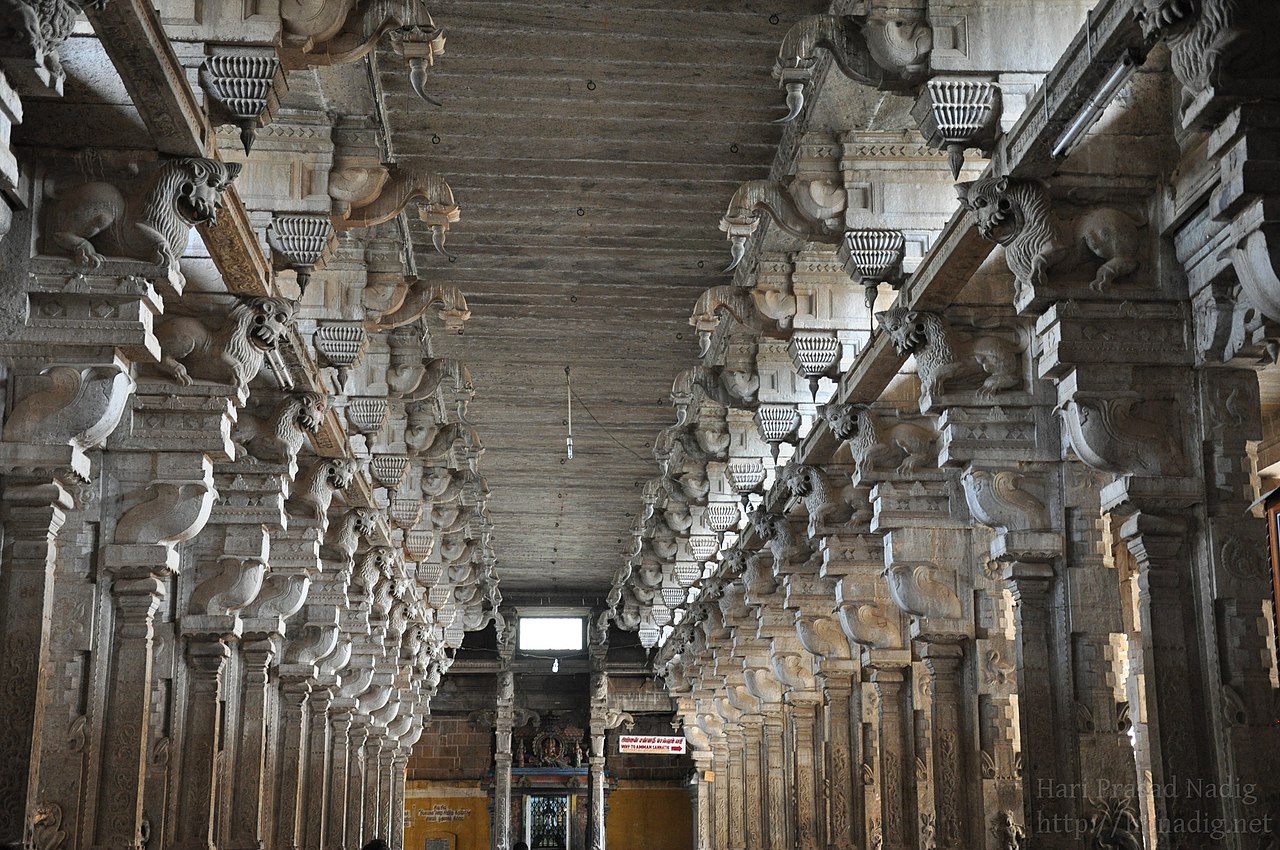
The Jambukeswarar Temple's architecture exemplifies Dravidian temple design at its most elaborate. Five concentric rectangular enclosures (prakarams) surround the central sanctum, each marked by towering gopurams (gateway towers) that announce the temple's presence from considerable distances. These prakarams create a spiritual progression—as you move from outer to inner enclosures, you're symbolically moving from the material world toward divine presence.
The temple's outer prakaram alone measures over 800 feet by 700 feet, making this one of the largest temple complexes in Tamil Nadu. The innermost enclosure contains the water-filled sanctum where Jambukeswarar resides, while Akilandeswari's shrine occupies a separate sanctum with its own elaborate architecture and daily worship schedule. The sheer scale of the complex demonstrates the devotional investment spanning centuries of patronage from various dynasties.
The Sacred Jambu Tree - Botanical and Spiritual Wonder
According to legend, an enormous jambu tree (rose apple tree) once stood at this location, and it was under this tree that the goddess performed her penance. While the original ancient tree no longer stands, its descendants grow within the temple complex, serving as living connections to the temple's mythological origins. The jambu tree holds special significance in Hindu tradition as a sacred species associated with several mythological events.
Devotees often circumambulate the jambu trees during their visit, believing that the trees retain some spiritual energy from the goddess's penance. The practice of worshipping sacred trees predates temple construction in Hinduism, and the Jambukeswarar Temple maintains this ancient tradition alongside more elaborate architectural worship.
Historical Timeline - Cholas to Present Day
The temple's history stretches back to the early Chola period, with inscriptions suggesting significant development during the 2nd century CE. However, the current architectural form largely reflects expansions and renovations conducted during the medieval Chola dynasty (9th-13th centuries) when temple building reached artistic and engineering peaks in Tamil Nadu.
Successive dynasties—the Pandyas, Hoysalas, and Nayaks—all contributed additions and renovations, each adding layers to the temple's architectural and spiritual complexity. British colonial administrators documented the temple in the 19th century, fascinated by both its architectural grandeur and the mysterious water source. Today, the Archaeological Survey of India recognizes the temple as a heritage site requiring preservation for future generations.
Daily Rituals - Six Times Touching the Divine
The temple conducts six elaborate pujas (worship services) daily, maintaining rhythms established centuries ago. Each puja follows strict Agamic procedures—ancient liturgical texts that specify exact sequences for every ritual action. The Ushakalam (dawn worship) begins around 5:30 AM, while the Ardha Jamam (night worship) concludes around 8:30 PM, bookending the day with divine consciousness.
What's particularly moving for visitors is witnessing priests perform abhishekam (ritual bathing) to the lingam while standing in the perpetual water that fills the sanctum. The sight of priests wading through water to reach the deity, pouring additional sacred substances (milk, honey, sacred ash) onto the lingam while natural spring water continuously flows—it creates a powerful visual representation of how the divine and natural worlds interact.
Festivals That Transform the Temple
During Maha Shivaratri, the great night of Shiva, Jambukeswarar Temple becomes a focal point for devotees across Tamil Nadu. Thousands arrive for all-night worship, believing that staying awake throughout Shivaratri night and offering prayers brings special blessings. The temple's corridors fill with chanting, oil lamps create flickering light shows on ancient stone pillars, and the air becomes thick with incense and devotional energy.
The annual Brahmotsavam festival spans ten days and showcases the temple's organizational capacity and cultural significance. Elaborate processions carry the deities around the temple streets on different vahanas (vehicles)—from peacock to elephant to silver chariot—each day featuring different ritual sequences and cultural performances that have remained largely unchanged for generations.
The Spiritual Experience - Beyond Tourism
Visiting Jambukeswarar Temple offers more than architectural appreciation or religious tourism—it provides an encounter with elements that constitute existence itself. The constant sound of flowing water in the sanctum creates a meditative background that enhances contemplative prayer. Many devotees report feeling unusual peace within the water element temple, as if the continuous water sound washes away mental turbulence along with physical impurities.
The temple's spiritual practices emphasize water's purifying properties—both literal and metaphorical. Water cleanses the body, but devotees also seek to cleanse karma, negative tendencies, and spiritual obstacles through prayers offered here. The element of water represents flow, adaptability, and persistence—qualities that spiritual seekers aspire to embody.
Connection to Srirangam - The Temple Circuit
Thiruvanaikaval's location adjacent to Srirangam makes visiting both temples in one trip highly convenient. Many pilgrims create a circuit: morning darshan at the Ranganathaswamy Temple (Vishnu), afternoon prayers at Jambukeswarar Temple (Shiva), creating a devotional balance between Vaishnavite and Shaivite traditions. This practice reflects Tamil Nadu's inclusive spiritual culture where sectarian divisions matter less than genuine devotion.
The two temples, though dedicated to different deities, share the same river geography, with the Kaveri River serving as sacred geography connecting these spiritual centers. Bathing in the Kaveri before temple visits remains a traditional practice, adding another layer of water element significance to the Jambukeswarar pilgrimage experience.
Practical Visitor Guide
The temple is located in Thiruvanaikaval, approximately 2 kilometers from Srirangam and about 8 kilometers from Trichy Junction railway station. Local buses, auto-rickshaws, and taxis provide easy access. The temple opens early at 5:30 AM and closes at 1:00 PM, reopening at 3:00 PM until 8:30 PM. This split schedule follows traditional temple patterns that respect the deity's "rest" time during afternoon hours.
There's no entry fee—the divine water element's blessings remain freely accessible regardless of economic status. However, special darshan options and archanas (special prayer services) are available for nominal fees for those seeking more personalized worship experiences. Photography is restricted in inner sanctums out of respect for religious sanctity, but outer areas allow photography for personal, non-commercial use.
Why Spiritually Inclined Travelers Shouldn't Miss This
For travelers seeking deeper spiritual experiences beyond surface-level temple tourism, Jambukeswarar Temple delivers something profound. This is a living, actively worshipped temple where ancient practices continue with undiminished intensity, where natural phenomena and spiritual significance intertwine inseparably, and where the fundamental element of water reminds visitors of life's essential, flowing nature.
The temple represents what makes Hindu practice distinctive—the belief that divinity manifests not just in anthropomorphic forms but through natural elements that sustain existence. Standing in the Jambukeswarar sanctum, hearing underground water flow through stone that has stood for centuries, you connect simultaneously to geological time, human spiritual tradition, and the mysterious life force that animates existence itself. That's not just tourism—that's transformation.
Photo Gallery

Visitor Information
Opening Hours
5:30 AM - 1:00 PM, 3:00 PM - 8:30 PM, Daily
Entry Fee
Free
Location
Thiruvanaikaval, Tiruchirappalli, Tamil Nadu, India
Contact
+91 431-223-0257
Related Articles & Guides
Famous Temples Around Trichy
Explore the magnificent temples that make Trichy a spiritual destination for millions of devotees.
Exploring Rockfort Temple and Its History
Journey to the top of Trichy's iconic Rock Fort and discover its fascinating history and spiritual significance.